Death of DeSoto: How Arkansas (Maybe) Took Out a Conquistador

Moving from New England back to Arkansas, where I went to college, was definitely a transition, but I have to say: spring here is something else. (Massachusetts fall will take the podium, but for now, the Natural State's nature is making my day.)

For the most part, I've been in a steady state, enjoying the new job, new house, and old friends. I am still in disbelief at how much time I have to explore my interests and build new hobbies, and I definitely want to soak that up. I feel like I lost a lot of years to overwork and over-worry, and now I'm able to, say, deep-dive needlessly into random topics of interest.

Having grown up in Texas, my state history lessons were largely a heavy-handed reminder to remember the Alamo. I'm not as familiar with the history of my new home. So today I wanted to explore a bit of arguable karmic justice in the form of the doomed voyage of the conquistador Hernando de Soto through the southern U.S. and his encounters with the many Mississippian tribes who lived there.

de Soto in the "New World": From Hubris to a Feverish Death on the ArkLa Border

The American Indian* communities who lived in the mid-South, including modern day Arkansas, in the early 1500s are known as the Mississippians. The term "Mississippian" is a broad one, referring to various cultural groups who lived in that area from approximately 900 to 1543. (The 1543 cutoff is due to the de Soto expedition we'll discuss today. These communities persisted, some to the present day, but the "Mississippian" period cuts off temporally.) Many Mississippian communities were well-populated and successful, including most notably the large city at Cahokia near modern St. Louis. Most were centered around farming, and tribes fought viciously with one another over prized land. The tribes in and near modern Arkansas specifically included the Caddo, the Chickasaw, the Natchez, the Osage, the Quapaw, and the Tunica.

* In this post, I have used the term "American Indian" or "Indian" to refer generally to the indigenous communities of the United States and have, wherever possible, used a specific tribal name. You can read more about this here.

Across the sea, Hernando de Soto was born in Jerez de los Caballeros in southwest Spain around the turn of the 16th century. His parents were thought to be middle-class lower nobility, and de Soto received a standard education in basic subjects.

Thanks to primogeniture, de Soto's older brother, Juan, was set to inherit everything from mom and dad, meaning de Soto needed to figure out a way to feed himself. He chose adventure. Or maybe his parents chose kicking him out of the house. Either way, his father sent him to Seville, the port city where de Soto first set sail, including an initial journey to the "New World" under Pedro Árias Dávila. (Also tagging along was Francisco Vázquez de Coronado, who would go north through "New Spain" [Mexico] to reach Kansas looking for the Cities of Gold.) This trip took de Soto to Central America where, in unfortunately typical conquistador fashion, the crew enslaved and killed the indigenous populations. de Soto in particular gained a fearsome reputation, leading several raids and becoming a captain by 1520. By 1524, he had "conquered" Nicaragua and been appointed a governor.

But this was not quite enough for de Soto. In 1530, he joined Francisco Pizarro on another expedition across the Atlantic. In Peru, the crew came across the vast Incan Empire. Using the weapons at their disposal, which included a panoply of diseases, the Spaniards (or, as they called themselves in firsthand accounts, the Christians) destroyed the civilization, capturing the chief Atahualpa and the capital Cuzco and robbing the Incans blind of their silver and gold.

Subsequently, de Soto went home to Spain and got hitched, which did nothing to tamper his fervor. After many attempts, he was finally given the backing to go to "La Florida"--that is, Florida.

In 1539, de Soto took off from Cuba to Tampa Bay and decided to head inland to seize land for Spain and pilfer gold and silver. He brought with him 600 soldiers, officials, priests, and other companions, including armored horses and a cotillion of hogs if needed for food. (Perhaps an omen for his Arkansas days, de Soto was for some reason charmed by the hogs and hesitant to eat them.) Interestingly, we have an impressive amount of (biased) information about de Soto's journey, as there are multiple firsthand accounts by members of his crew.

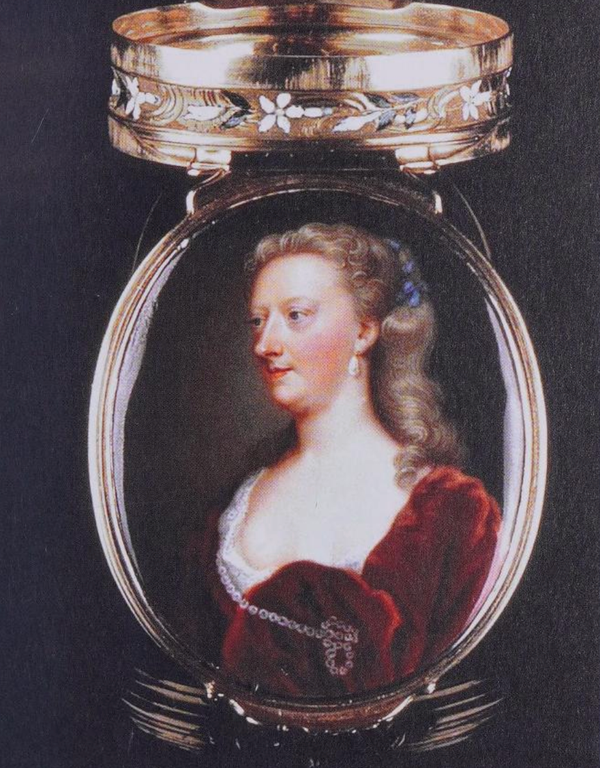
de Soto striking a humble pose

The Spaniards followed native trails, hopping from one tribal establishment to another. Their accounts often clumped together the name of a tribal leader, the name of the people, and the name of the site.

Nicely for his beloved swine but inconveniently for the natives, he and his men fostered resentment by leeching corn from the Indians, often a year's worth of crops in the course of a single week. They also indentured various indigenous people to be makeshift servants and translators, torturing those who did not comply. Which is not to say the Indians did nothing in response: they attacked the Spanish repeatedly, often using the element of surprise. Their appearance was terrifying to the Europeans: the men had painted their skin in various colors, were decorated with feathers and horns, and painted their faces black, outlining their eyes in red. They used brutal tactics, at one point burning an officer's wife (Francisca de Hinestrosa) alive.

In this depiction, Chickasaw warriors utilize a surprise attack against the Spanish, suffering only 1 casualty for the Spaniards' 12.

At some point, near Chickasaw territory, the Spaniards came across Juan Ortiz, who had survived an earlier Floridian expedition in 1528 and learned the language of the Timucua. Ortiz tagged along as a translator, badgering the Indians about gold and silver. The indigenous peoples, who treasured shells and artworks and thus had no idea where to point them, often sent the Spaniards in random directions away from their settlements, often conveniently to their enemies. (I imagine something like telling the Jehovah's Witnesses at your front door that the annoying guy down the street has been expressing strong interest in Armageddon.)

In 1541, de Soto reached the Mississippi Valley. Along the way, he'd launched battles merely as a show of force, abducted hundreds of native women for sexual assault, and otherwise raised chaotic hell. That May, he and his crew camped on the eastern side of the River in what scholars believe was a Tunica community near modern-day Memphis. While preparing to cross the Mississippi, a group of Indians arrived in a 200-canoe fleet from Aquixo, in what is now Arkansas. They painted a foreboding image: the boats were huge, carrying one hundred warriors each, and the occupants were gilded in paint and feathers. The leader sat under a canopy and offered de Soto fish and other gifts. He said he was a representative of Pacaha, a powerful leader who ruled over a dominant community to the north. de Soto, paranoid and uncharmed, ordered his men to fire upon the Indians, who immediately withdrew.

It took the Spaniards a month to construct rafts sturdy enough to cross what they called the "Rio Grande," which was the Mississippi (not to be confused with the Rio Grande). Eventually, they were able to float across, becoming (possibly) the first Europeans to do so.

de Soto's Arkansan journey began at Quizquiz, just over the border near what is now Memphis, Tennessee

When the Spaniards reached Aquixo, they found it abandoned. Many groups, having heard of the Spanish traipsing around, fled in advance. Continuing forward in a southerly direction, they reached Casqui, a well-established Mississippi town that had existed for hundreds of years. The remains of its fortified center can be found at Parkin Archeological State Park in Parkin, Arkansas.

The Casqui welcomed their guests with food and hides, even at the expense of part of their food supplies. The Spaniards used the hides to refashion their dilapidated wardrobes. First-hand accounts speak of "very fierce" decor at Casqui, including dried buffalo skulls.

In what may well be post-hoc religious lore, one story goes that, having heard of the Christian God, the Casqui asked that the Spanish priests speak to it and request rain to alleviate a recent prolonged drought. The Spaniards then erected a large cross on the Casquis' temple mound. The Spanish then claimed it rained the next day, and as a result, the locals believed de Soto possessed extraordinary power just as he claimed. (Again, it is not clear if this story is true at all. In fact, you'd think the takeaway would be that the Christian God had extraordinary power, not the guy pleading for it, but that's beside the point.)

Not intimidated enough by de Soto to refrain from lying, the Casqui told the Spaniards that the Pacaha (possibly near modern day Osceola) had the gold they sought and that, as a result, the Spaniards should assist in attacking them. Days later, the Spanish soldiers joined Casqui warriors in battle at a large (but goldless) town in Pacaha territory. The Casqui looted their foes; took captives and, worse, scalps; and desecrated sacred sites. Apparently this was not too unusual of a fight, as the Spanish, Casqui, and Pacaha all stuck around for a while and reached relative peace.

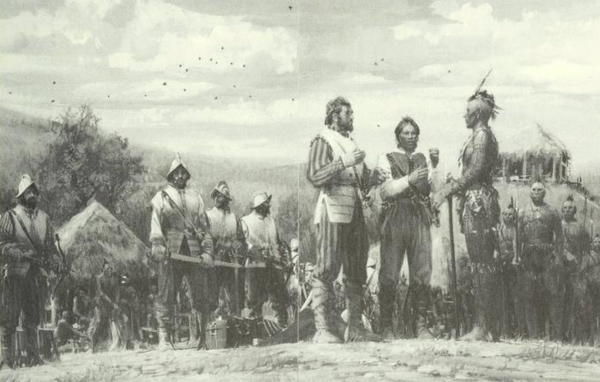
The Spanish meet with an unidentified Mississippian chief in a painting by John Berkey

Both the Casqui and the Pacaha tried to secure de Soto's loyalty via marriage to their noblewomen. de Soto did have a one-track mind, but it was not on that: it was on riches. Therefore, he continued south, hoping for gold. (The Spanish were also desperate for salt, no doubt having a less-than-ideal culinary experience. Incans reported that, at one point, hungry Spanish soldiers had downed handfuls of salt like it was sugar.)

de Soto and his men reached Quiguate, thought to have been the largest of the towns they ultimately visited. However, while there, they heard of Coligua (or Coligoa), a large province to the northwest and said to be in a mountainous region. (This could be modern day Little Rock, which is not quite in a mountainous region. However, two fine hiking spots including Petit Jean and Pinnacle Mountain.) This report was promising to the Spaniards, who believed gold and silver could be found up in the mountains. (Which is typically true due to geological forces. Just not in Arkansas.) The Spaniards marched forward across wet empty land, eventually reaching a section of the White River near modern-day Batesville and the edge of the Ozarks. In what was becoming a pattern, the surprised Indians living there were quickly found to be without gold.

Again foiled, the Spanish army headed south again, dizzily zigzagging through various communities until they reached Cayas in the Arkansas River Valley. Unlike the fortified towns the Spaniards had encountered before, Cayas, though populous, consisted of a sprawl of farms. The farms--surprise, surprise--did not have gold.

Then going up the Arkansas River, the Spaniards entered the Ouachita Mountains and an area south of Fort Smith, near the Oklahoma border. There resided the Tula (likely Caddo or a related tribe) who spoke their own language that the translators did not understand. The Tula also did not seem particularly eager to have teatime conversations: they were skilled buffalo-hunters and used those techniques to fight the Spanish cavalry, resulting in heavy losses by both sides. The accounts described the Tula as "the best-fighting people the Christians met with." They were certainly an ego-wound to the Spanish, who not only found no gold (again) but also little food.

At this point, in Game of Thrones-like fashion, the Spanish knew winter was coming. The crew was wasting and growing frustrated. de Soto backtracked to the Mississippi Valley, reaching a town in south-central Arkansas called Utiangue (Autiamque). The winter of 1541-1542 was brutal. One account wrote: "It was so cold and there was so much snow that we thought we would die." Ortiz, the translator who had by then survived nearly 15 years in the "New World," did in fact perish, hampering further de Soto's ability to communicate with the indigenous tribes. Like the Tula, the also-nearby Chocktaw were indecipherable to de Soto's remaining translators.

As spring sprung, the Spanish headed east, toward the River's edge, and reached Anilco, which was possibly the Menard-Hodges Site in rural Arkansas County. The residents had fled but sneaked home at night to grab their corn. This starved the Spaniards out, so they carried on south to Guachoya, where the Arkansas and Mississippi rivers meet. If all of this meandering sounds random, it's because it was: there was no plan, and the expedition had become a hodgepodge of destructive wandering.

de Soto, growing desperate, sent out part of the cavalry in a doomed trip to find an outlet to the sea. Unable to trot the approximately 400 miles required, the men returned days later unsuccessful. The increasingly panicked de Soto sent a messenger to a nearby tribal chief, boldly demanding various riches. The chief (Quigualtam), correctly sensing a weakened de Soto, said "Sure, if you dry up the Mississippi River." Unsurprisingly unable, de Soto was humiliated and enraged.

In a fury, he ordered his men to attack Anilco (which was not where the chief was, incidentally). The soldiers acted in line with the unjustified wrath of their leader, slaughtering hundreds of innocents, including children. Their brutality horrified even their own countrymen.

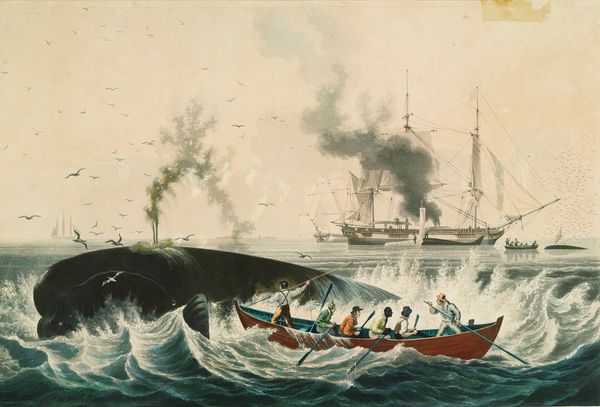
Shortly thereafter, karma delivered de Soto an intense fever, possibly typhus (tabardillo). He died days later at the age of approximately 42. Fearing that his death may signal to any lasting believers that de Soto had no magical powers or to any lasting detractors that de Soto's corpse was ripe for desecration, his men quietly dropped his body into the Mississippi. (A more morbid version states the men had originally buried him and told local Indians that the godly leader had merely taken a brief heavenly vacation, as he often did. The Indians were rightly skeptical. Fearing as much, the Spaniards dug up de Soto's body, weighted it down, and set it in the river.)

A depiction of the death of de Soto

There is quite the dispute as to where de Soto actually perished. I, unbiasedly, will say it was either Lake Village or McArthur, both in southeast Arkansas. But there is a not-insubstantial chance that Ferriday, Louisiana can claim his corpse. (Which is also fine with me, as a good Cajun.)

After burying their leader at the closest to a sea they could actually find, his beleaguered army, only half their original number or worse, barely escaped down the Mississippi River to Mexico, arriving empty-handed and having "conquered" no one. Throughout their journey, they were attacked by various tribes, who were justifiably infuriated by the Spaniards' actions.

The entire Arkansas expedition was a costly failure. It devastated the Southeastern Indians of the region through murder and plunder. Modern scholarship suggests these horrors coincided with climatological changes that caused drought and other misfortune, compounding the Indians' suffering. (Disease also contributed, but it is not clear that de Soto's expedition, in particular, drove this.) Much like Columbus, de Soto's impulsiveness ("thoughtlessness" [corto de razones]) and brutality were reported even by contemporaries, who noted he "hunted" Indians like they were animals and sent "many to hell."

And, more generally, the expedition garnered the whole of Spain absolutely nothing. It was a stark blow to de Soto's reputation: he had put all his eggs in the basket of La Florida and failed. Spain gave up on the region entirely, never sending another explorer anywhere near it. In fact, the next Europeans to set foot in Arkansas were the French over a hundred years later in 1673. In large part because of the disaster of de Soto's "adventure," they found completely different people on their journey than de Soto had encountered.

As a result, de Soto's Arkansas expedition offers a fascinating and devastating snapshot of a very particular moment of time and confluence of people. Sites like Parkin offer interesting glimpses--such as tokens the Spanish traded like coins, bells, and bullets--that confirm the two "worlds" collided. However, even with multiple accounts by Spanish survivors, we know very little about this era.

I remember reading about American Indians and their encounters with Europeans in school and thinking, "God, it must have been like meeting an extraterrestrial." In college, I had a great history professor who went out of his way to provide a more unbiased presentation of the meeting of the "Old" and "New" Worlds, noting both the horrors of the conquistadors and "settlers" but also the ferocity of the Indians themselves. This was a nice throwback to that, and it's reassuring that scholarship has become much more multi-faceted since my Americans-shared-corn-and-smiled days. I enjoyed today's deep dive into intense, in some ways impressive, but ultimately human people. Hope you did too.

Sources:

Subscribe to Deeply Unnecessary

Sign up now to get access to the library of members-only issues.
Jamie Larson
Subscribe